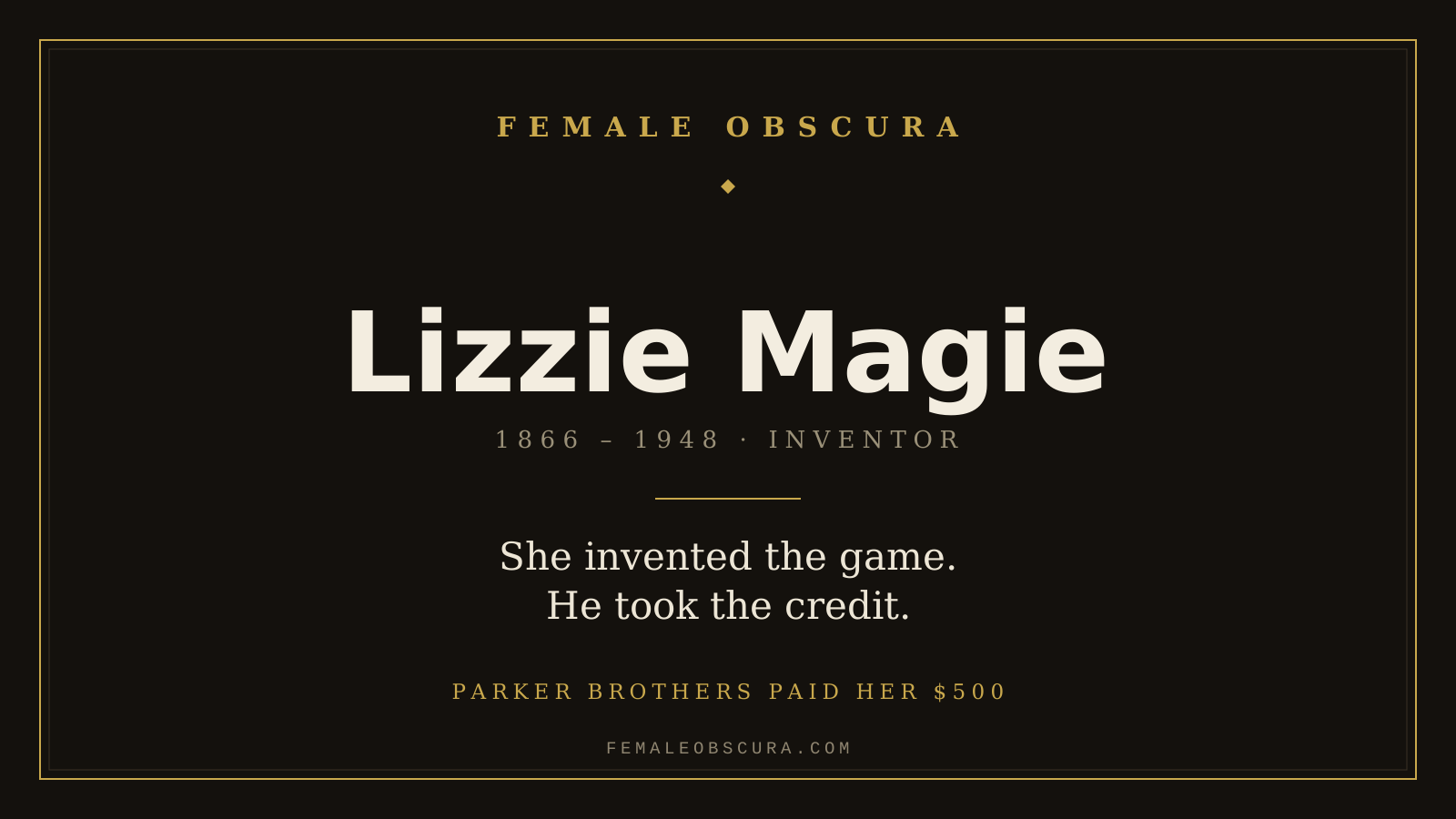
She invented the world’s best-selling board game to warn against greed. A man sold it as his own and got rich.
The best-selling board game in history was patented in 1904. Not by the man whose name is stamped inside the box, and not in a Depression-era basement.
It was patented by a stenographer who built it to prove that landlords rob everyone else. Three decades later a salesman copied a homemade version, called it his own invention, and became the first board-game millionaire. She was paid five hundred dollars and no royalties.
Her name was Elizabeth Magie.
The game was an argument
Elizabeth Magie was born in Macomb, Illinois, on May 9, 1866. Her father was an abolitionist newspaper editor who had traveled with Abraham Lincoln, and he raised a daughter who did not intend to be quiet. She moved to the Washington area, supported herself as a stenographer at a time when almost no woman did, held a patent for a typewriter device in her twenties, wrote poetry, and once bought a newspaper advertisement offering herself “for sale” to the highest bidder to protest how few options women were given.
She was also a committed follower of the economist Henry George, who argued that land should belong to everyone and that a single tax on land value would break the grip of the wealthy. To teach that idea, Magie built a board game.
She filed for a patent in 1903 and received U.S. Patent No. 748,626 on January 5, 1904, for The Landlord’s Game. It had a square track, four corners, railroads, utilities, properties to buy, and a “Go to Jail” space. Anyone who has played Monopoly has played her board.
Here is the detail almost everyone misses. Magie wrote two sets of rules. In one, all players were rewarded when wealth was created. In the other, the goal was to crush your opponents into bankruptcy and build a monopoly. She built the second set to show how ugly it was. It is the version the world adopted.
From a teaching tool to one man’s fortune
For thirty years Magie’s game spread by hand. It was played on college campuses, passed between Georgist circles and Quaker communities in the Northeast, and reworked along the way. A Quaker group in Atlantic City added local street names. The game had become folk property, and its inventor’s name traveled less well than the board did.
In the early 1930s a man named Charles Darrow was taught a homemade version by friends who had learned it from that folk chain. Darrow wrote down the rules, drew up the board, and in 1935 sold it to Parker Brothers as Monopoly, his own creation. He received a patent for it in December 1935. Parker Brothers wrapped the product in an inspiring story: a struggling salesman who dreamed the game up in his basement during the Depression to save his family.
None of it was true, and the company soon learned so. Once Parker Brothers discovered Magie’s prior patent, it moved to secure control. In November 1935 it bought her Landlord’s Game patent and two of her other game designs. It paid her five hundred dollars. No royalties.
Darrow became rich and was celebrated for decades as the inventor of Monopoly. Magie watched the game conquer the world with the single-tax lesson she had built into it quietly ignored by nearly every player. She died in Arlington, Virginia, in 1948. The 1940 census lists her occupation as “maker of games.” Her obituary did not call her the inventor of Monopoly. No one did.
She said it out loud, and was not heard
Magie did not stay silent. In January 1936, at the height of the Monopoly craze, she went to the Washington Evening Star and laid it out. The paper ran a photograph of her holding all three boards, her 1904 Landlord’s Game, her 1924 revision, and Darrow’s Monopoly, and reported that she had sold her rights for a flat five hundred dollars.
The story ran, and the myth rolled straight over it. The basement fable was better for business, and it stayed on the box.
The reversal
The truth surfaced by accident. In 1973, an economics professor named Ralph Anspach was sued by Parker Brothers over his own game, Anti-Monopoly. Fighting the case, he dug into the archives and uncovered Magie’s patents and the folk-game lineage that Parker Brothers had buried. A decade-long legal battle dragged the real origin of Monopoly into the public record.
The Darrow myth still persists in plenty of retellings. But the patent number is Magie’s. The 1936 newspaper is Magie’s. The two rule sets, one cooperative and one cruel, are hers, and the fact that the world chose the cruel one is exactly the argument she was trying to make.
She built a game to expose the system. The system took the game, put a man’s name on it, and paid her five hundred dollars to go away. The record says otherwise now.
The archive grows. The silence shrinks. Enter the archive.
Sources:
- The Woman Inventor Behind “Monopoly” — Smithsonian, Lemelson Center for the Study of Invention and Innovation
- Monopoly’s Lost Female Inventor — National Women’s History Museum (by Mary Pilon)
- The Very Fascinating Elizabeth J. Magie — Library of Congress, Inside Adams
- Game-board, U.S. Patent No. 748,626 — Elizabeth J. Magie, granted January 5, 1904 (via Google Patents)