Not a blog. A reckoning.
There is a bust of a woman in a library in Stockton, California. I stood in front of it and asked who she was. Nobody could tell me.
Her name was Harriet Chalmers Adams. She had been the most famous female explorer in the world. She wrote for National Geographic. She crossed more of the globe than nearly any woman of her era. The city thought enough of her to cast her in bronze.
And her archive sat downstairs, largely unread.
How it is done
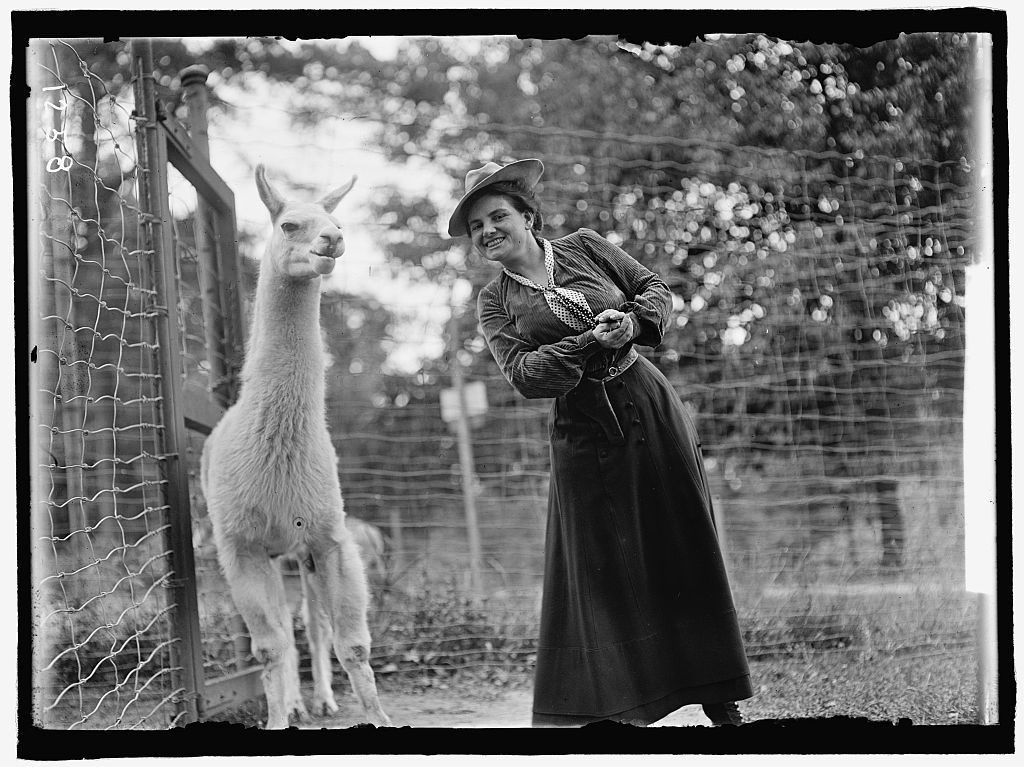
The photograph above is held by the Library of Congress. This is how it is catalogued, word for word, today:
ADAMS, MRS. FRANKLIN, NEE HARRIET CHALMERS. AT ZOO WITH LLAMA
Franklin Adams did not cross the Andes. He did not report from the trenches at the French front. He did not write for National Geographic for three decades.
She did all of it. And in the national archive of the United States, her name arrives third, after her husband’s, behind the word “nee.” The llama is doing about as well as she is.
Nobody burned her papers. That is not how it works. It is done in a caption, by a clerk, in a filing decision nobody thought twice about.
The question that started everything
If Harriet Chalmers Adams could disappear, who else had?
How many scientists had their papers published under a man’s name. How many warriors had their battles credited to their brothers. How many inventors watched their patents filed by their husbands.
I started digging. I have not stopped.
Female Obscura is the answer to that question, built one woman at a time. Deeply researched articles. Videos that treat the material with the weight it deserves. An archive that reaches across centuries and continents, and grows with every woman we pull back.
What we do differently
Most women’s history content covers queens, consorts, and socialites. Women who were remembered because power kept a record of them.
We cover the ones power removed.
Scientists. Warriors. Artists. Naturalists. Inventors. Women whose contributions were minimized, misattributed, or erased outright, and whose names you have never heard for exactly that reason.
Every story here is a case to be solved. We work from primary sources. We name the men who took the credit. We show the paper trail.
What we believe
The historical record has a deliberate blind spot. Not an accident. A pattern.
Accuracy over sensationalism. These lives are extraordinary on the facts alone. They do not need embellishment.
Every silence was a choice. So is every story told.
History is not neutral. Neither are we.
The archive is never finished until the silence is gone.
If you have already watched all the obvious ones
You know the feeling. You go looking for forgotten women and you get Marie Curie again. You search “women in history” and it is another queen, another consort, another woman remembered because she married power.
You are not looking for inspiration. You are looking for the record.
This is for the reader who already knows a lot of history and is certain something was left out on purpose. Who has gone three pages deep on a name and found nothing, and understood that the nothing was the point. Who wants exact dates, named sources, and the specific mechanism of how a woman’s credit was taken, not a soft profile about how remarkable she was.
If you teach, this is also for you. Every article runs on primary sources and names them, so you can take it straight to a classroom without rebuilding the research yourself. Your students have never heard of a single woman who was not already in the textbook. That is fixable.
Anyone who has read a footnote and thought: wait, who was she. Start there.
The work continues
Every article is a resurrection. Every video pulls one more woman back from deliberate silence.
The record is incomplete. We are fixing it.