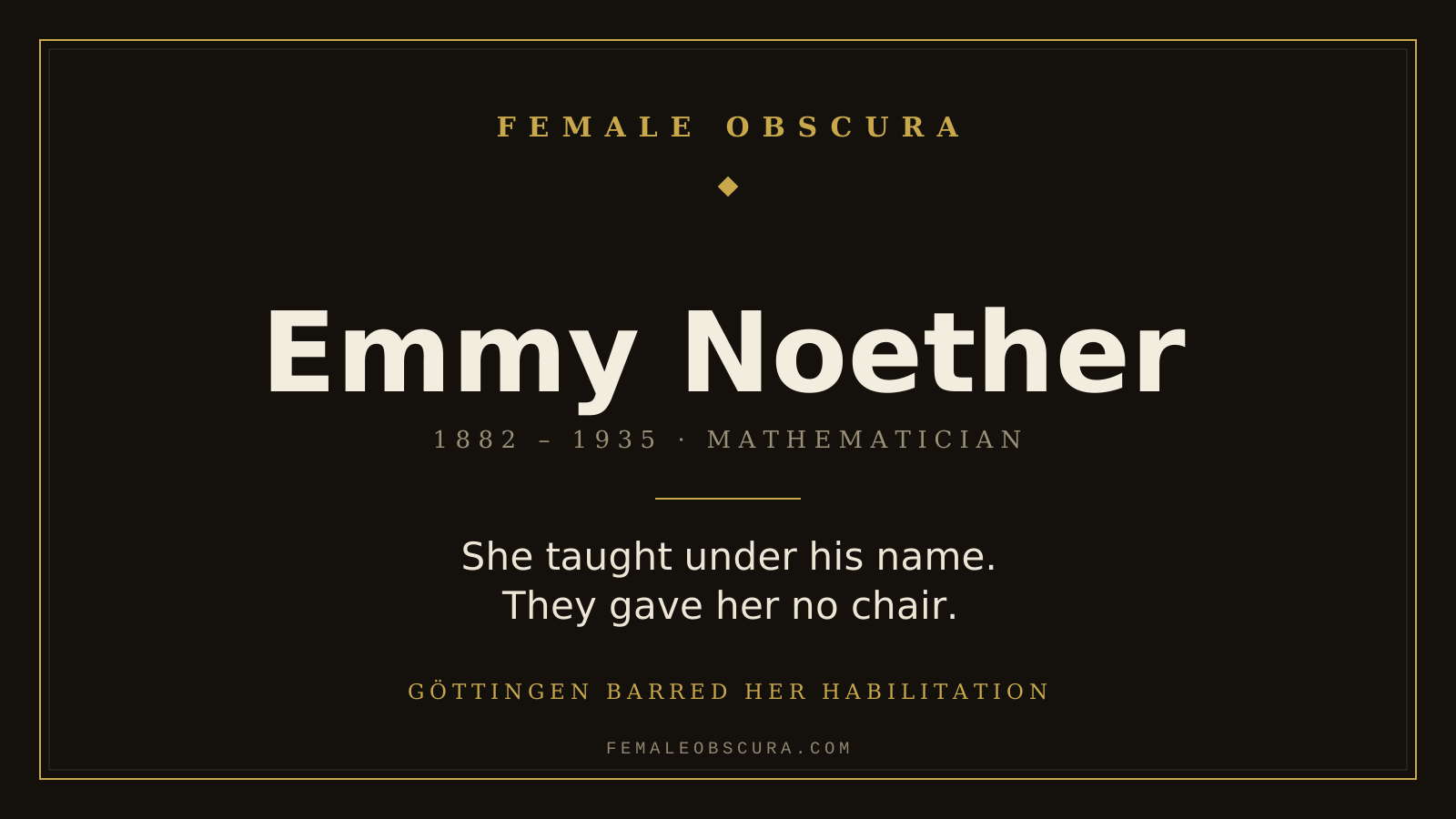
She found the symmetry behind every conservation law in physics. They made her lecture under a man’s name.
For four years, the University of Göttingen printed her course under someone else’s name.
The seminar was hers. The name over the door was not.
Her name was Emmy Noether.
The lecture catalog for the winter of 1916 lists a seminar in mathematical physics given by Professor David Hilbert, “with the assistance of Dr E. Noether.” Hilbert was not teaching it. Noether was. The fiction was the only way the university would let a woman stand at the front of the room.
She was already one of the most important mathematicians alive.
What she proved
Born in Erlangen in 1882, Noether took her doctorate there in 1907, under Paul Gordan, with the highest distinction. German universities had no place to put her. The next rank, the habilitation that opened the door to teaching, was closed to women. So she worked at Erlangen for years without pay and without a title, supervising doctoral students who were officially credited to her father.
In 1915 Hilbert and Felix Klein brought her to Göttingen, then the center of the mathematical world. They needed her. Hilbert was deep in the mathematics of Einstein’s new general relativity and wanted the best mind on invariant theory that he knew. She arrived and solved the problem in front of them.
The result is now called Noether’s theorem, published in 1918. It says that every continuous symmetry in a physical system corresponds to a conserved quantity. If the laws of physics do not change over time, energy is conserved. If they do not change across space, momentum is conserved. The link between symmetry and conservation, which physicists had used piecemeal for a century, she proved as a single general law. It sits under quantum field theory and particle physics to this day.
Einstein wrote to Hilbert praising her penetrating mathematical thinking. The theorem carried her name into physics. Her salary did not follow.
The faculty that voted her down
When Hilbert and Klein moved to make her position official in 1915, the philologists and historians on the philosophical faculty blocked it. Their objection was not about her work. No one disputed the work. Their objection was that a woman could not be a Privatdozent. One faculty member is recorded protesting what the returning soldiers would think if they found they had to learn at the feet of a woman.
Hilbert was her champion, not the obstacle, and he did not hide his contempt for the vote. As Hermann Weyl later recounted it, Hilbert told the faculty that he did not see how the candidate’s sex was an argument against her, since the university senate was not a bathhouse. The line is quoted often and softened often. The fact behind it is not in dispute. The university would not admit her.
So Hilbert put his own name over her lectures and let her teach. For four years she taught Göttingen’s students as an assistant to a course that was hers. Her habilitation was finally granted in 1919, after the collapse of the old regime and a wave of university reform, not because the faculty changed its mind.
The chair that never came
Even the habilitation did not make her a professor with a salary. In 1922 she was given the title of adjunct professor, the first woman in Germany to hold one, and from 1923 a small stipend for teaching algebra. That was the ceiling. She never held a paid chair. The most creative algebraist of her generation ran the strongest mathematical activity at Göttingen from an unsalaried post.
Her ideas spread the same way her lectures had, under other names. Much of her work reached the world through the papers of her students and the books of her colleagues. The second volume of van der Waerden’s Moderne Algebra, the text that taught modern algebra to a generation, is largely hers. The credit diffused. The record thinned.
Erased twice
In April 1933 the Nazi state finished what the faculty had started. Under the Law for the Restoration of the Professional Civil Service, Noether was dismissed from Göttingen for being Jewish. She received no pension. A neighbor had already denounced her as a Marxist Jewess and driven her from her apartment. The government that had never paid her now removed her entirely.
She left for the United States that October, to a temporary post at Bryn Mawr funded by the Rockefeller Foundation, and she lectured at the Institute for Advanced Study in Princeton. Even there the pattern held. Seventeen occasional visiting lecturers spoke at the Institute in those years and were paid honorariums. All seventeen were men. Noether, the one the Institute itself called unique in the world, received none.
She died in April 1935, days after surgery, at 53. Einstein, writing in the New York Times, called her the most significant creative mathematical genius produced since the higher education of women began.
What the record owes her
Noether is not unknown. Her theorem is taught, a crater bears her name, and physicists invoke her constantly. This is not a case of a woman no one remembers. It is a case of a woman the institutions of her time refused to pay, refused to title, and finally refused to keep, while taking everything her mind produced.
The name went on the theorem. It came off the lecture list, off the salary roll, and off the faculty. She held the discipline together from a post that did not officially exist.
Restoring the record, one woman at a time. The archive grows. The silence shrinks. Enter the archive.
Sources:
- Emmy Noether — MacTutor History of Mathematics, University of St Andrews
- Emmy Noether — Encyclopaedia Britannica
- Emmy Noether’s Paradise — Institute for Advanced Study
- In her short life, mathematician Emmy Noether changed the face of physics — Science News
- Scientist of the Day: Emmy Noether — Linda Hall Library