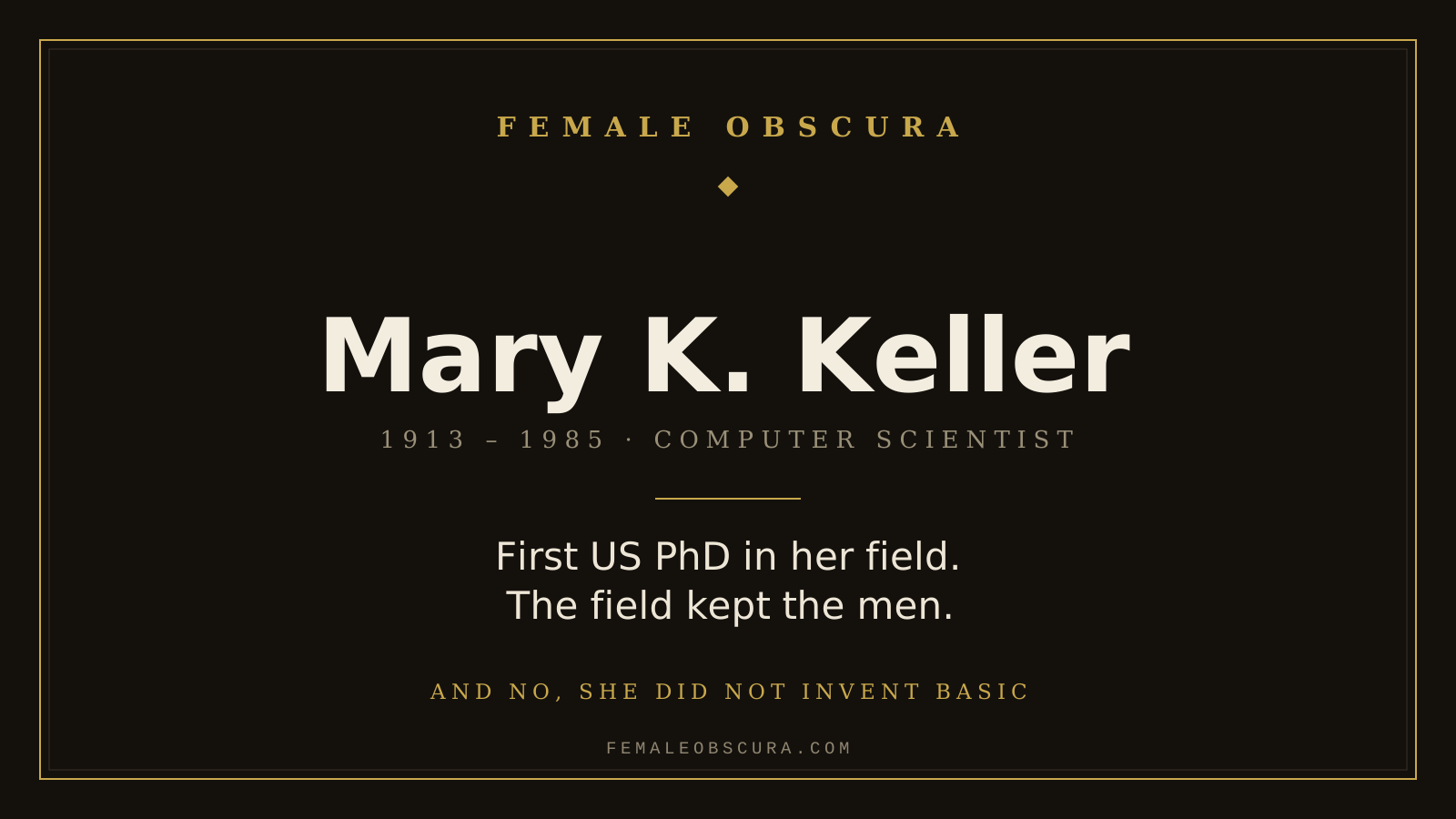
She earned one of the first computer-science doctorates in America, the first by a woman. The field it became remembers the men.
On the day the United States handed out its first two doctorates in computer science, one of them went to a nun.
She had spent years talking her way into computer rooms that did not admit women, at a time when the discipline did not yet have a name.
Her name was Mary Kenneth Keller.
She helped begin the field of computing in America and then built a place for other people to enter it. The standard history of that field does not have room for a Catholic sister at a small women’s college in Iowa. Even the attempts to remember her get her wrong.
The first, on the same day as the first
She was born Evelyn Marie Keller in Cleveland, Ohio, on 17 December 1913. In 1932 she entered the Sisters of Charity of the Blessed Virgin Mary and took the name Sister Mary Kenneth. She took a bachelor’s and then a master’s in mathematics and physics, and in the early 1960s she moved toward a machine that barely existed as a subject of study.
On 7 June 1965, the United States awarded its first two doctorates in computer science. One went to Irving Tang, for a thesis in applied mathematics. The other, the same day, went to Mary Kenneth Keller, a PhD in computer science from the University of Wisconsin. Her dissertation built algorithms to do analytic differentiation, teaching a machine to do a piece of mathematics itself. She was one of the first two people in the country to hold the degree, and the first woman to hold it at all.
This is not a contested claim padded for effect. It took a later correction of the record by the computer scientist Ralph London to establish who was first, and a 2023 study in the IEEE Annals of the History of Computing to give her the plain title: the first United States PhD in computer science.
No, she did not invent BASIC
Here the archive has to correct her own admirers.
You will read, in a hundred tributes, that Keller helped create the programming language BASIC at Dartmouth. She did not. She attended a summer program at Dartmouth’s computer center in the early 1960s, at a time when Dartmouth had relaxed its rule barring women from the machines, and she was in that world as the language was being born. But BASIC was built by John Kemeny and Thomas Kurtz, and Keller was not one of its authors. She became one of the language’s finest teachers and co-wrote a textbook that used it in 1973. That is the true, smaller, more useful fact.
The false version is worth naming because of what it does. In reaching for a headline achievement to make her matter, it buries the achievements that were actually hers, and it quietly implies she needed a man’s famous invention attached to her name to be worth remembering. She did not.
What she actually built
What she did was rarer than co-authoring a language. She built a door.
In 1965, with her doctorate finished, Keller founded the computer science department at Clarke College, a small Catholic women’s college in Dubuque, Iowa, run by her own order. It was one of the first computer science departments at any small college in the country, and she ran it for twenty years. She won a National Science Foundation grant for undergraduate equipment, helped found a national association for small-college computing, and wrote four books.
Her argument, decades before it was fashionable, was that the computer was the greatest interdisciplinary tool ever built, and that its power was access. She wanted it in the hands of students the emerging industry was not looking at, including women, at a college the industry would never have noticed. She died on 10 January 1985.
Who gets written into the story
There is no villain here. No one stole a result from Mary Kenneth Keller. The mechanism is quieter and just as effective. The story computing tells about itself is a story of young men and famous machines, and a nun who took the first doctorate and spent her career widening the door at a women’s college does not fit the shape of it. So she falls out of the telling, and when she is put back in, she is dressed in someone else’s invention to make her legible.
The truth needs no costume. She was there at the start, credentialed before almost anyone, and she spent the rest of her life letting other people in.
We find them. We tell their stories. The archive grows. The silence shrinks. Enter the archive.
Sources:
- The Legacy of Mary Kenneth Keller, First U.S. Ph.D. in Computer Science — Jennifer Head and Dianne P. O’Leary, IEEE Annals of the History of Computing, 2023
- Mary Kenneth Keller — Wikipedia
- Who Earned First Computer Science Ph.D.? — Ralph L. London, Communications of the ACM, 2013
- The First Woman to Earn a PhD in Computer Science Was a Nun — Mental Floss (Adrienne Crezo), which corrects the BASIC claim